

Losing a Passion, Finding a Purpose
After three paralyzing injuries, a Miami Project patient becomes a partner
By Christina Hernandez Sherwood
Photography by Adam Detour

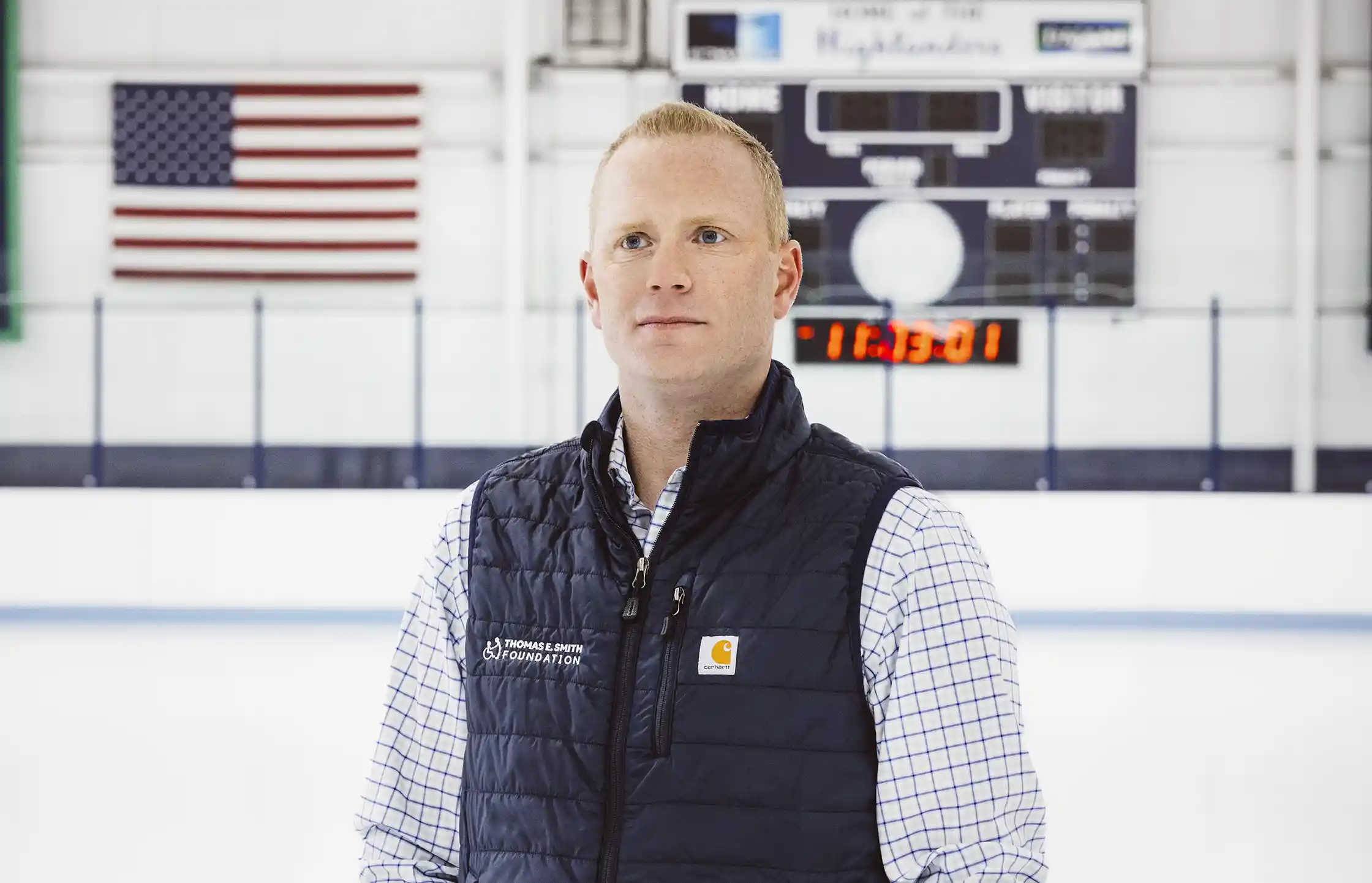
Tom Smith aims to profoundly impact health care for those with paralysis.
W
hen Tom Smith suffered a paralyzing injury as a 19-year-old ice hockey player in 2008, doctors told him he’d be confined to a wheelchair within two years. Realizing he needed more specialized, advanced care, he traveled from his Massachusetts home to meet Barth Green, M.D., chairman and cofounder of The Miami Project to Cure Paralysis at the Miller School.
“Dr. Green said to me, ‘I’m not going to sugarcoat this: you have a very bad cervical injury,’” Smith recalled. “‘However, you came to The Miami Project to Cure Paralysis, and if I don’t get you back on skates, I won’t have done my job.’”
Smith, who had dreamed of being a professional hockey player, knew he’d found his doctor. After an intense regimen of physical therapy overseen by The Miami Project, Smith was back on the ice within a year.
During late 2009 and early 2010, however, Smith suffered two additional paralyzing injuries unrelated to his first one — one playing hockey and the other in a car crash. Both were in his thoracic spine. While all three injuries were incomplete breaks, the second and third resulted in Smith’s paralysis from the waist down.
“In my 50 years of experience, I’ve never had another patient who’s had three paralyzing injuries,” said Dr. Green, who is also the executive dean of global health and community service and professor of neurological surgery, neurology, radiology, orthopaedics and rehabilitation medicine.
At only 20 years of age, Smith had lost his ability to play hockey — his life’s passion — for good. “It was a fight or flight moment,” he recalled. “If I didn’t have a purpose, I wasn’t going to make it.”
While he was hospitalized at a Boston trauma center, Smith shared a room with a gunshot victim who couldn’t pay for the wheelchair ramp he would need to access his home. Smith, on the other hand, had the financial resources to fund the treatments, physical therapy and assistive devices he needed.
“If you can’t afford access to the proper health care and medical equipment that it takes to live a full life with paralysis, you’re not going to get it,” Smith said. “You need outside support.”
Rewiring the Outdated Continuum of Care
Smith had found his purpose. He co-founded the Thomas E. Smith Foundation, a nonprofit that supports individuals with spinal cord injuries and paralysis. The foundation has donated more than $2 million to research and to people living with paralysis, Smith said. It helps pay for physical therapy, home modifications, equipment and more.
The foundation has partnered with The Miami Project to improve the standard of care for people with paralysis and for their families and caregivers. “Our goal is to rewire the outdated continuum of care,” Smith said, “and profoundly impact both short- and long-term health care for people with paralysis — not only in Miami, but across the country and around the world.”
Today, Smith remains partially paralyzed in his right leg but can walk with forearm crutches. He keeps in shape with a regimen that includes cycling and physical therapy. “I’m a product of what access to proper health care, medicine and equipment can do for an individual,” Smith said. “It can give you your life back. We want everyone to live the fullest life they can.”
A Long-standing Partnership
The Miami Project, which celebrates its 40th anniversary this year, was one of the Smith Foundation’s earliest partners. In 2015, Smith completed a 2,100-mile journey — combining bicycling, wheelchair biking and walking — from the Boston area, where he was first injured, to where he was treated in Miami to raise money for his foundation. “My story is not the only one of someone being paralyzed, going to The Miami Project and walking again,” Smith said. “We’ve been such big supporters, because we see the tangible results of where our money goes.”
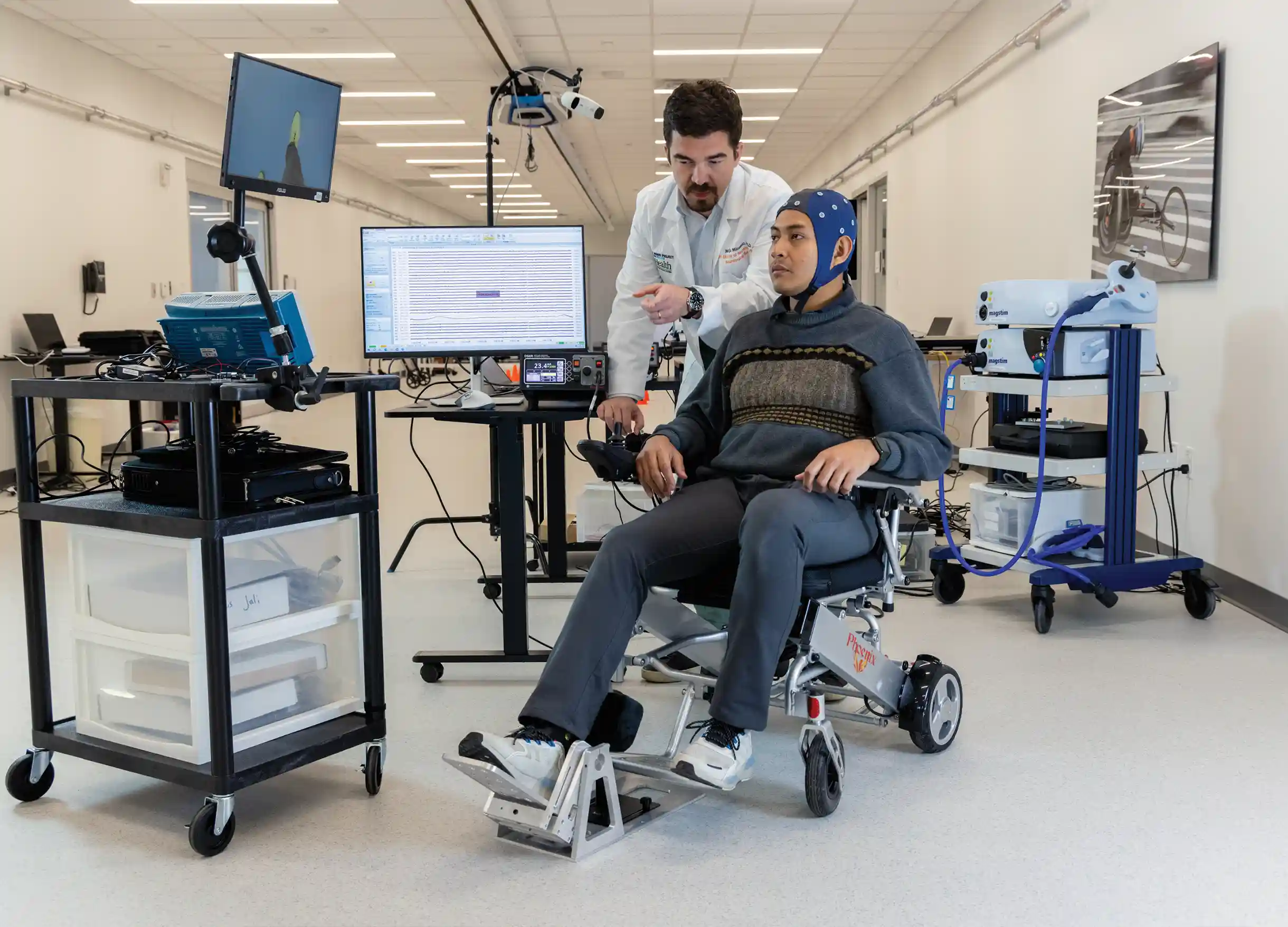
Smith’s foundation has donated $184,000 in the past two years to support the work of Matija Milosevic, Ph.D., director of neuromotor rehabilitation at The Miami Project and assistant professor of neurological surgery at the Miller School. An additional $20,000 was donated to support other projects.
Neuromodulation, Dr. Green explained, can enable the nervous system to learn efficient “detours” that bypass an injured area of the spinal cord to make new neural connections and recover long-lost mobility. Through these technologies, “patients have regained a function that’s been gone for decades — not days or weeks or months,” he said. “It gives me goose bumps thinking about not just the possibilities, but what the probabilities are in the future!”