

Journey From Patient to Doctor
Antonio Fontanella will study the disease that defined his childhood
By Bob Woods
Photography by Peter Freed

Antonio Fontanella wants to help other patients receive their “miracle.”
W
hen Antonio Fontanella, B.S. ’20, was 3, he was diagnosed with a kidney disease. It gradually progressed to the point where, at 14, he required a kidney transplant. Today, Fontanella is an M.D./Ph.D. student in the Miller School’s Medical Scientist Training Program, on a pathway to become a nephrologist.
You might say that Fontanella’s journey from patient to doctor was preordained. His father is an internal medicine physician, and his parents emigrated in 1995 from Cuba to Miami. A few years later, Antonio Fontanella, then a toddler, was diagnosed with idiopathic nephrotic syndrome. Even so, Fontanella recalled, “I was pretty functional until early high school, when I started to need dialysis.”
By that time, his father had taken a job at a military clinic in Alabama, though Fontanella and his family were traveling back and forth to Miami for treatments. His disease advanced to a condition known as focal segmental glomerulosclerosis (FSGS), in which the kidneys’ filters — the glomeruli — are scarred and gradually lose proper function. Ultimately, he progressed to end-stage kidney disease, necessitating a transplant. The family then turned to the nephrology experts at UM/Jackson Memorial Hospital for the transplant. “Thank God, my mother was compatible as my living donor,” Fontanella said.
After 40 days recuperating in the hospital, “I felt like a normal kid again,” Fontanella said. “I could eat whatever I wanted, drink as much water as I wanted, and I had so much more energy to go wherever and do whatever I wanted.”
Fontanella’s circuitous medical ordeal fueled his desire to become a doctor. That process began, appropriately enough, at the University of Miami, where he completed a dual major in biochemistry and molecular biology. “It felt right to be in the place where I got well,” he said.
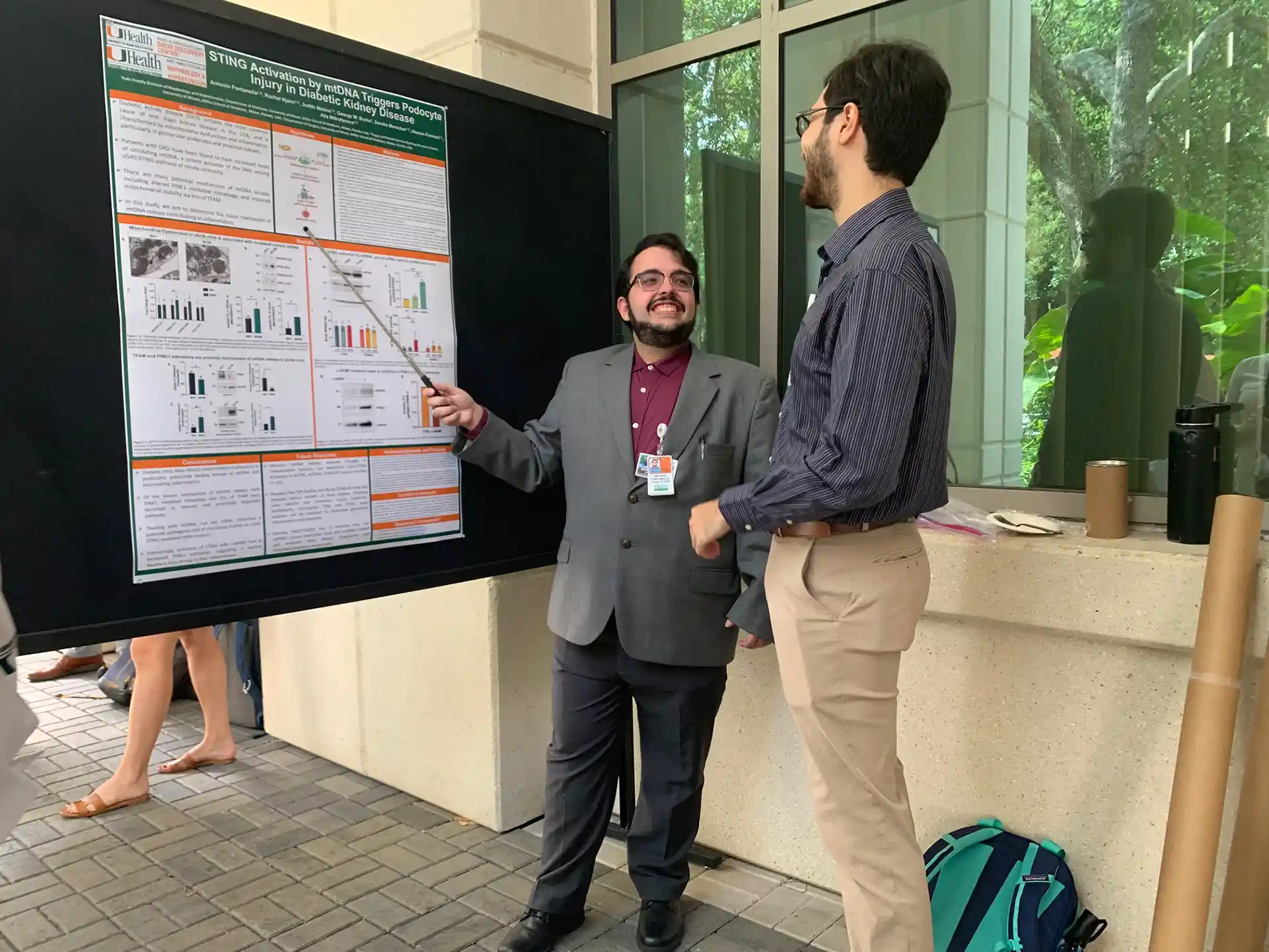
In keeping with that theme, the Miller School was not only his first choice for medical school, but also was where he joined a nephrology research team headed by Alessia Fornoni, M.D., Ph.D., Fellowship ’01, director and chair of the Peggy and Harold Katz Family Drug Discovery Center, professor of medicine and molecular and cellular pharmacology, chair of the Medical Scientist Training Program and the recently named assistant dean for research training and development.
“Dr. Fornoni was involved in one of the studies that was a crucial part of my treatment, and working in her lab pushed me toward the physician-scientist route,” Fontanella said. His long-term goal — not surprisingly — is to find a cure for FSGS.
“At the UM/Jackson Hospital System, our motto is ‘Miracles Made Daily,’” he said. “I feel blessed and thankful to contribute to the community where I received my miracle, and look forward to using my training as a physician-scientist to help other patients receive theirs.”